


World’s Simplest Poker: A Complete Analysis of the Discrete Analogue
Published:
Some notes on what happens to poker when the deck shrinks to a handful of numbered cards, and why the only stable way to play even three of them involves a little bluffing.
World’s Simplest Poker, a two-player game devised by Duke economist David McAdams, strips poker down to its bare bones: each player antes a dollar, receives a single card, and makes a single choice between betting and folding. In McAdams’s version, each card is a random number between 0 and 1, while in the discrete version we studied, the cards are simply numbered 1 through $n$. Personally, I find the discrete version a perfect sandbox for game theory, since it is small enough to work out by hand while still being rich enough to require bluffing. As part of a project led by Professor A.J. Hildebrand at the University of Illinois, we wanted to know whether any simple way of playing this game beats all the others, and if not, what the best way to play actually looks like. The answer, at least for three cards, is no: every simple strategy has a counter, and the counters chase each other in circles. In fact, the only stable way to play is to always bet on the best card and to bet on each of the other two exactly a third of the time.
Simple Poker 101
If you’re already familiar with zero-sum games and Nash equilibria, feel free to skip to The Real Stuff.
As always, let’s call on our friends Alice and Bob. On slow evenings, the two of them play a stripped-down version of poker with only three cards, numbered 1, 2, and 3. Each of them puts a dollar on the table, the cards are shuffled, and each draws one, so that they never hold the same card and whoever holds the higher one has the stronger hand. Then, without knowing what the other will do, each chooses either to bet, adding a second dollar, or to fold. If one bets and the other folds, the bettor takes the table and comes out a dollar ahead. If both bet, they turn their cards over and the higher card takes two dollars from the other; if both fold, they still turn their cards over, and the higher card takes a single dollar1. Whatever Alice wins, Bob loses, and vice versa, so neither of them can come out ahead without the other falling behind by exactly the same amount.
At first, both of them play by simple habits. Alice, who likes action, bets on every card she draws, while Bob bets only when he holds a 2 or a 3. Since there are only six ways to deal two of the three cards, Alice can work out exactly how this goes over a long run of evenings by adding up what each deal pays her and dividing by six. The answer is not kind to her: she loses a third of a dollar per hand. This is because every time she bets a low card into Bob’s bet, she pays two dollars to his higher card. She soon learns two rules of thumb from this. Against a player who bets on almost anything, it pays to be a little more careful than he is. Against a player who almost never bets, however, it pays to bet on everything, since he will fold and hand over his dollar.
Over time, their habits grow stranger. Bob starts betting on his 3 and on his 1 (a pure bluff, since a 1 can never win a showdown), while folding his 2. Alice answers by betting on everything, since a bluffing Bob pays her two dollars whenever she bets into his 1 with a higher card. Bob then drops the bluff and bets only on his 2 and 3, which punishes Alice’s reckless betting, so Alice retreats to betting only on her 3. Bob, seeing how rarely she bets, goes back to bluffing with his 1, and the two of them have come full circle. This is very much like a game of rock, paper, scissors, in which every choice beats one other choice and loses to another, so no single choice is ever safe.
The way out of the circle is to stop being predictable. For example, suppose Bob always bets on his 3. Whenever he holds a 1 or a 2, he rolls a die and bets only if it lands on a 1 or a 2, so that he bets those cards a third of the time. Alice can search for whatever reply she likes, but nothing she does wins her any money on average; if she adopts the same rule, nothing Bob does wins him any money either. At that point, neither of them has any reason to change, and the game settles into a truce in which, over a long run of evenings, both of them break even.
The Real Stuff
Every part of Alice and Bob’s evenings corresponds to a piece of the paper’s model:
- Alice and Bob → Players
- Player A and Player B, who play a symmetric, zero-sum game.
- Their cards are written \(c_A\) and \(c_B\).
- Three Cards → Playing Set
- The deck is \(N = \{1, 2, \ldots, n\}\), and the paper focuses on $n = 3$.
- Cards are drawn without replacement, so \(c_A \neq c_B\) and there are $n(n-1)$ possible deals.
- Dollars → Payoffs
- A bet against a fold wins the folder’s ante, or 1.
- A showdown after two folds pays 1, and a showdown after two bets pays 2.
- Alice’s Habit → Cutoff Strategy
- Player $x$ bets if and only if \(c_x \geq k_x\), for some cutoff \(k_x\).
- A low cutoff makes a ‘risky’ player, and a high one makes a ‘safe’ player.
- Odd Habits → Betting Sets
- A betting set \(\mathcal{B}_x\) is any subset of cards to bet on, such as Bob’s ${1, 3}$.
- There are $2^n$ of them, and every cutoff strategy is one, namely \(\{k_x, \ldots, n\}\).
- Die Rolls → Bluffing Strategies
- A probability vector \((p_1, \ldots, p_n)\), where \(p_i\) is the chance Alice bets on card $i$.
- Bob’s probabilities are written \((q_1, \ldots, q_n)\).
- Lessons → Best Responses
- The strategy that maximizes a player’s payout against a fixed opponent, which the paper finds with a minimax search.
- Rock, Paper, Scissors → Intransitivity
- Best responses that loop back on themselves, so that no strategy is dominant.
- The Truce → Nash Equilibrium
- A pair of strategies in which neither player can gain by changing alone.
Everything in the paper comes back to how Alice fares on an average evening, which is her payout on each possible deal averaged over all of them:
\[\underbrace{\mathbb{E}_A}_{\text{Alice's average evening}} = \frac{1}{\underbrace{n(n-1)}_{\text{possible deals}}} \sum_{c_A \neq c_B} \underbrace{E_A(c_A, c_B)}_{\text{what one deal pays Alice}}\]Because the game is zero-sum, Bob’s average evening is exactly the negative of Alice’s, so it is enough to study hers.
Three Cards
We began with the simplest interesting case, in which the deck has three cards and both players use cutoffs. For example, suppose Alice bets on everything (a cutoff of 1) and Bob bets on his 2 and 3 (a cutoff of 2). Alice then wins a dollar by forfeit whenever Bob holds the 1 and wins two dollars when her 3 meets his 2, but she loses two dollars in each of the three deals where she bets a lower card into his bet. That comes to $-2$ over the six deals, or $-\frac{1}{3}$ per hand, which is the loss Alice suffered in the story. Repeating this for every pair of cutoffs gives the full picture:
| Alice’s cutoff | Bob bets on all | Bob bets on 2, 3 | Bob bets on 3 |
|---|---|---|---|
| Bets on all | 0 | −1/3 | 0 |
| Bets on 2, 3 | +1/3 | 0 | −1/6 |
| Bets on 3 | 0 | +1/6 | 0 |
The zeros along the diagonal follow from the game’s symmetry, since two players with the same habit should break even, and swapping the players’ cutoffs flips the sign of the payout. Interestingly, betting only on the 3 never loses to another cutoff in this table. However, as I explain in Rock, Paper, Scissors, that safety disappears as soon as Bob is allowed habits that are not cutoffs, which is part of why we widened the analysis beyond them.
Any Deck
For a deck of any size, we split each deal into six outcomes, named by what each player did and whether Alice won. Both players can fold, with Alice winning or losing the showdown; Alice can bet while Bob folds, or fold while Bob bets; and both can bet, with Alice again winning or losing. Counting how many deals lead to each outcome, weighting each by what it pays, and summing gives a closed form for Alice’s expected payout when she plays more safely than Bob (that is, when \(k_A > k_B\)):
\[\mathbb{E}_A(k_A, k_B) = \frac{3k_A k_B - k_B^2 - 2k_A^2 + 2k_A - 2k_B + n k_A - n k_B}{n(n-1)}\]The case where Bob plays more safely follows from symmetry, since \(\mathbb{E}_A(k_A, k_B) = -\mathbb{E}_A(k_B, k_A)\), and the payout is zero whenever the two cutoffs match2. Setting $n = 3$ recovers every number in the table above, which is a useful check on a formula with this many moving parts.
Reading the Room
With a formula in hand, we could ask the question that matters to Alice: given Bob’s cutoff, what should hers be? When Alice plays more safely than Bob, her payout is a downward-opening parabola in her own cutoff, so it peaks where its derivative is zero, at
\[k_A^* = \operatorname{round}\left(\frac{2 + n + 3k_B}{4}\right).\]When she plays more riskily than Bob, the parabola opens upward instead, so the best she can do there lies at an endpoint, and one of those endpoints (the cutoff just below Bob’s) always loses money. Thus, Alice’s best reply is always one of two choices: the peak above, or betting on every card, whichever pays more. For example, in a 50-card game against a Bob who bets on everything, the peak puts Alice’s best cutoff at 14, which earns her about 13 cents per hand. Against a Bob who bets only on his 50, however, she should bet on everything and collect about 94 cents per hand, since he folds almost every time.
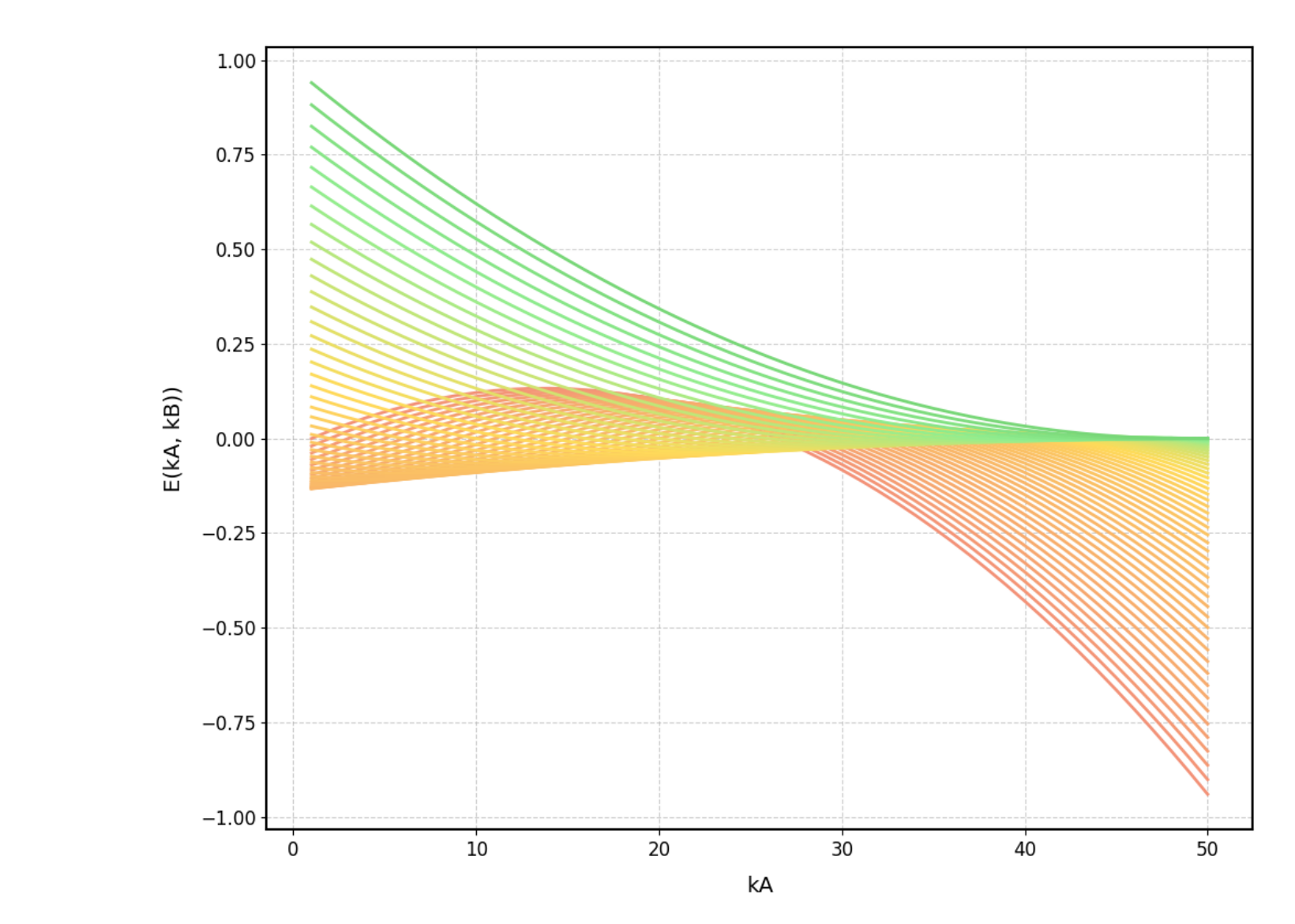 Alice’s expected payout as her cutoff rises in a 50-card game, with one curve for each of Bob’s cutoffs. Against a safe Bob (the green curves that start high), betting on everything pays best; against a risky Bob (the red curves), her payout peaks near a cutoff of 14 and collapses if she grows too cautious.
These curves are exactly the two rules of thumb from the story. Against a risky player, it pays to be somewhat safer than he is, and against a safe player, it pays to bet on everything.
Rock, Paper, Scissors
Cutoffs are only some of the ways to play, so we next allowed each player to bet on any subset of cards. With three cards, there are eight such betting sets per player, from never betting at all to betting on everything, and sixty-four possible match-ups between them, which is few enough to write out in full.
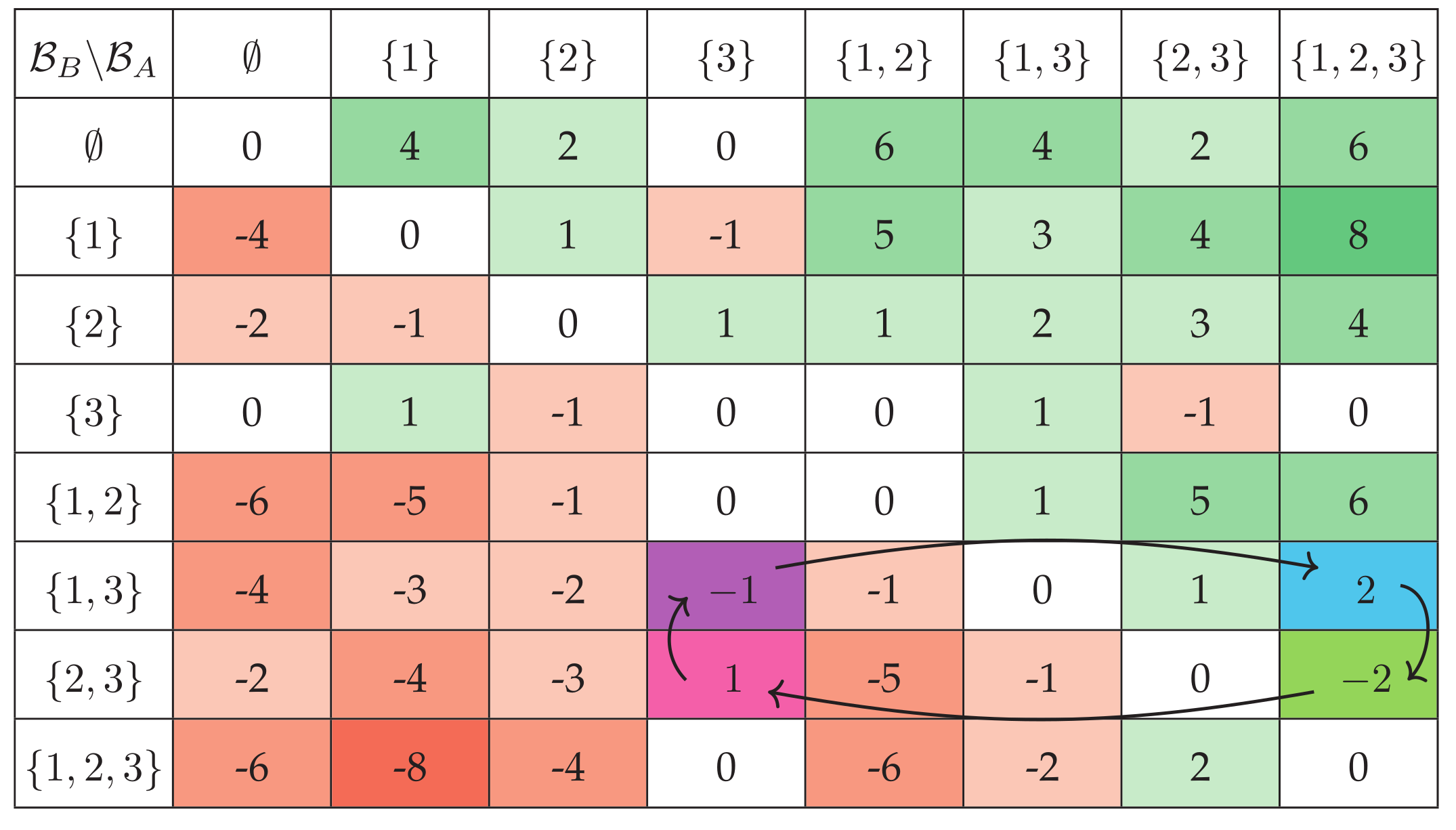 Each entry is Alice’s total winnings over the six possible deals (six times her expected payout) when she bets on the column’s cards and Bob bets on the row’s. The arrows trace the cycle from the story, in which every best response is itself beaten by the next.
Reading the table the way Alice and Bob would, a player looks along the opponent’s row or column for the entry that serves them best. Against Bob’s bluffing habit of ${1, 3}$, Alice’s best reply is to bet on everything, which earns her a third of a dollar per hand. Bob’s best answer to that is ${2, 3}$, which turns the same habit into a third of a dollar lost. Alice’s best reply then becomes ${3}$, worth a sixth of a dollar to her. Against ${3}$, Bob returns to ${1, 3}$, which costs Alice a sixth of a dollar per hand, and the loop begins again. This is also why betting only on the 3, so safe against cutoffs, fails here: Bob’s bluff with the 1 beats it. In fact, no betting set in the table is safe, since each one loses to at least one other. As such, neither betting sets nor cutoffs (which are a special case of them) contain a dominant strategy3.
Rolling Dice
Since every fixed habit can be exploited, the natural next step was to let players randomize, betting on each card with some probability. For three cards, Alice’s expected payout against Bob’s probabilities works out to
\[\mathbb{E}_A = \frac{(4 - 3q_2 - 3q_3)\,p_1 + (2 + 3q_1 - 3q_3)\,p_2 + 3(q_1 + q_2)\,p_3 - 4q_1 - 2q_2}{6}.\]This formula is linear in each of Alice’s probabilities, which has a surprising consequence: against any fixed strategy of Bob’s, Alice’s best reply is never random. She should bet on a card whenever its coefficient is positive and fold it whenever its coefficient is negative, and only when a coefficient is exactly zero does she have any reason to randomize. The coefficient on her 3 can never be negative, so she should always bet on it. As such, a careless opponent is easy to punish. For example, suppose Bob ignores his own card entirely and bets with the same probability $q$ on every card. Alice’s best reply is then to bet on everything whenever $q$ is below two thirds, which earns her $1 - q$ dollars per hand.
The Truce
Nash’s theorem guarantees that every finite game like this one has at least one equilibrium, and since no pair of fixed habits is stable, the equilibrium must involve randomness. Taking Bob to always bet on his 3, Alice’s coefficients simplify to \(1 - 3q_2\) for her 1 and \(3q_1 - 1\) for her 2, and both have a very intuitive reading. This is because, when Alice holds the 1, Bob holds either the 2 or the 3, and he always bets on the 3. Thus, the only thing that matters is how often he bets on the 2, and Alice should bluff with her 1 exactly when Bob bets his 2 less than a third of the time. Likewise, when Alice holds the 2, Bob holds either the 1 or the 3, so she should bet her 2 exactly when Bob bluffs with his 1 more than a third of the time.
If Bob strays from a third in either direction, Alice has a reply that wins her money. Therefore, the only way for Bob to avoid being exploited is to make Alice indifferent by setting both probabilities to exactly a third. By symmetry, the same holds for Alice, which leaves a single equilibrium:
\[(p_1, p_2, p_3) = (q_1, q_2, q_3) = \left(\tfrac{1}{3}, \tfrac{1}{3}, 1\right)\]At this equilibrium, both players earn exactly zero on average, which is what one would expect from a symmetric game, and any other strategy gives the opponent a way to come out ahead. Personally, I believe this is the most satisfying result in the paper: bluffing with the worst card is not a trick reserved for bold players, but a requirement of playing well, and the right amount of it can be computed exactly.
So What?
- No Best Habit
- Every fixed strategy, whether a cutoff or a betting set, has a counter that beats it.
- Best responses chase each other in a loop, much like rock, paper, scissors.
- Bluffing Is Required
- The only stable way to play three cards is to bet on the 3 and to bet on the 1 and 2 each a third of the time.
- Any player who bluffs more or less than that can be exploited.
- Indifference Decides
- The equilibrium comes from making the opponent indifferent, not from maximizing against a fixed opponent.
- A best reply to any fixed strategy is never random, which is exactly why fixed strategies keep losing.
- Small Games Teach
- Three cards and one bet are already enough to produce intransitivity and bluffing.
- That makes this model a useful sandbox for building intuition about larger poker games.
Final Notes
- Three-Card Proof
- The equilibrium is proven only for $n = 3$.
- Whether a similar pattern holds for larger decks, and what form it takes, is still open.
- Larger Decks
- The paper states that the cycling of betting sets continues for every deck of three or more cards.
- That claim rests on the three-card table and on pattern-spotting, so I would treat it as a well-supported conjecture rather than a theorem.
- Rounding Rule
- The best-response cutoff is a continuous optimum rounded to the nearest card.
- When it falls exactly halfway between two cards, the paper’s convention rounds up.
- Toy Model
- Each player gets one card, there is one simultaneous round of betting, and there are no raises, bankrolls, or repeated play.
- Real poker differs in nearly every one of these respects, which our future directions aim to close.
As always, if you’ve read this far, thank you! My hope is that the clean answer we found for three cards turns out to be the first case of a general pattern, one that tells a player exactly how often to bluff in a deck of any size. The full paper, with all six payout cases and every derivation I skipped here, is available here, and the project page also has the poster where the figures above first appeared. If you work on game theory or have thoughts on the general case, I’d love to hear from you.
If you’d like to cite this:
@misc{gupta2025discrete,
  title  = {World's Simplest Poker: A Complete Analysis of the Discrete Analogue},
  author = {Gupta, Aryan and Tandon, Mihir and Medina, Andres},
  year   = {2025},
  url    = {https://aryan-cs.github.io/poker-like-games/discrete-edition.pdf}
}
In real poker, a hand never goes to a showdown after everyone folds. In this model, however, both antes are still on the table, so the higher card takes them, which means that folding a 1 always costs a dollar no matter what the opponent does. ↩
The formula treats cutoffs as running from 1 (bet on everything) to $n$ (bet only on the highest card). A player who never bets at all is not a cutoff strategy in this setup, though it does appear among the betting sets later on. ↩
I don’t mean to suggest that the loop in the table is the only one. Several entries tie for the best reply in places, so Alice and Bob could trace other cycles through the table, but every path eventually runs into a strategy that some other strategy beats. ↩